

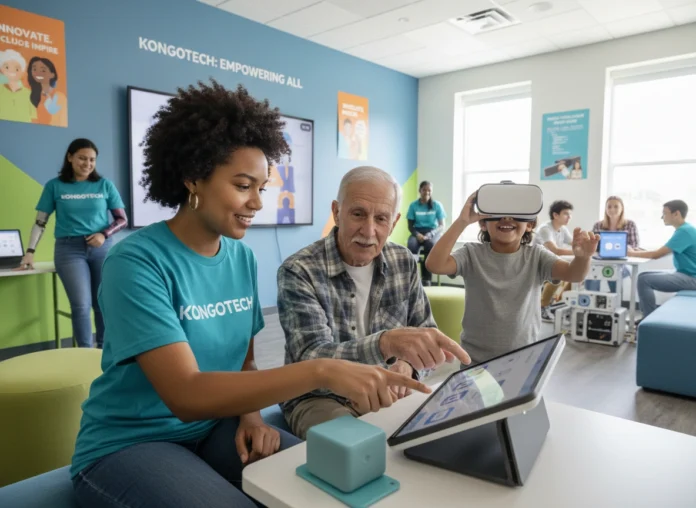


The digital divide remains one of the most pressing challenges of our time. While innovation accelerates at breakneck speed, millions of people find themselves left behind, unable to access the tools, connectivity, or skills needed to participate in the modern economy. For technology to truly be transformative, it cannot be exclusive. This belief sits at the core of Kongotech’s operations.
Kongotech has emerged not just as a technology provider, but as a bridge builder. By focusing on affordability, digital literacy, and infrastructure development, the company is systematically dismantling barriers that prevent diverse communities from accessing essential tech. This article explores how Kongotech is reshaping the landscape of technological accessibility, turning the promise of connectivity into a reality for underserved populations.
The Mission: Access as a Fundamental Right
At the heart of Kongotech’s philosophy is the idea that access to technology is no longer a luxury—it is a fundamental right. In an era where education, healthcare, and employment are increasingly digital-first, being offline means being invisible.
Kongotech’s mission statement emphasizes “Empowerment through Connectivity.” This isn’t just corporate speak; it translates into a strategy that prioritizes users who are typically overlooked by major tech conglomerates. While other companies chase the highest margins in saturated urban markets, Kongotech looks toward rural areas, low-income urban districts, and developing regions where the digital gap is widest.
Their approach is three-pronged:
- Hardware Accessibility: Lowering the cost of entry for devices.
- Infrastructure Expansion: Bringing reliable internet to “last-mile” locations.
- Educational Empowerment: Teaching people how to use these tools effectively.
Breaking Down Financial Barriers with Affordable Hardware
The most immediate hurdle for many potential technology users is cost. High-end smartphones and laptops are priced well beyond the means of the average global citizen. Kongotech has tackled this head-on through its “Essential Series” line of devices.
The Essential Series: Innovation on a Budget
Rather than stripping down premium devices until they are barely functional, Kongotech rethought the design process. They focused on durability, battery life, and essential connectivity features while deprioritizing costly aesthetic flourishes. The result is a line of smartphones, tablets, and lightweight laptops that are rugged, reliable, and cost a fraction of market leaders.
For example, the K-Tab 4, a tablet designed specifically for students in developing economies, comes pre-loaded with offline educational resources. This ensures that a lack of constant internet connection does not equate to a lack of learning. By using open-source operating systems and partnering with local manufacturers to reduce shipping costs, Kongotech keeps prices low without sacrificing the quality necessary for daily use.
Circular Economy Initiatives
Beyond manufacturing new affordable devices, Kongotech has pioneered a robust refurbishment program. They partner with large corporations to collect retired enterprise hardware. These devices are wiped, repaired, and upgraded before being redistributed to non-profits and community centers at near-zero cost. This initiative not only provides hardware to those who need it but also significantly reduces electronic waste, aligning accessibility with sustainability.
Bridging the Connectivity Gap: Infrastructure for the “Last Mile”
Owning a device is only half the battle. Without a reliable connection, a smartphone is just a digital paperweight. Kongotech has invested heavily in innovative infrastructure solutions designed to bring connectivity to hard-to-reach areas.
Solar-Powered Wi-Fi Hubs
In regions where electricity is unreliable or nonexistent, traditional cell towers struggle to operate efficiently. Kongotech introduced Solar-Mesh technology—a network of solar-powered Wi-Fi hubs that can be easily installed in remote villages. These hubs create localized networks that connect to the broader internet via satellite backhaul.
This innovation has been a game-changer for rural healthcare clinics. Doctors in remote areas can now access cloud-based patient records and consult with specialists in major cities via video link, effectively bringing modern medicine to places that previously had none.
Community Internet Partnerships
Recognizing that individual data plans can be prohibitively expensive, Kongotech works with local governments to establish “Community Digital Zones.” In these zones, often located in public libraries, markets, or schools, high-speed internet is subsidized. Kongotech provides the technical infrastructure, while local municipalities cover a portion of the operational costs. This public-private partnership model ensures sustainability and prevents the financial burden from falling solely on the end-user.
Digital Literacy: The Key to True Inclusion
Access to hardware and internet is the “what” of technology, but digital literacy is the “how.” Without the skills to navigate the digital world, users cannot unlock its full potential. Kongotech understands that dumping hardware into a community without training is a recipe for failure.
The “Tech for All” Academy
Kongotech launched the “Tech for All” Academy, a mobile education unit that travels to underserved communities. These units are essentially classrooms on wheels, equipped with workstations and staffed by trainers who speak local dialects.
The curriculum is tailored to the specific needs of the community:
- For Farmers: Training focuses on using apps to track weather patterns, monitor crop prices, and access agricultural extension services.
- For Small Business Owners: Workshops cover digital payments, social media marketing, and basic bookkeeping software.
- For Seniors: Classes focus on video calling to stay in touch with family, avoiding online scams, and accessing telemedicine services.
By contextualizing technology, Kongotech ensures that users see immediate, practical value in digital adoption. This relevance drives engagement and retention far better than generic computer classes ever could.
Empowering Women in Tech
A specific pillar of their educational outreach is the “Code-Her” initiative. In many regions, the digital divide has a stark gender component, with women and girls having significantly less access to technology than men. The Code-Her program provides scholarships and dedicated coding bootcamps for young women.
Graduates of this program often go on to become the IT support specialists for their own communities, creating a cycle of empowerment. By placing women at the center of the technological conversation, Kongotech is not just teaching skills; they are shifting cultural norms regarding who “belongs” in the tech space.
Innovating for Disabilities
Accessibility also means ensuring that technology is usable by people with disabilities. Standard interfaces often assume a level of vision, hearing, and motor control that not everyone possesses. Kongotech has dedicated a dedicated R&D wing to Assistive Tech.
Voice-First Interfaces
For users with visual impairments or low literacy levels, text-based interfaces are a significant barrier. Kongotech has integrated advanced Natural Language Processing (NLP) into their budget devices. This allows users to navigate menus, send messages, and access information entirely through voice commands in regional languages, not just major global languages like English or Mandarin.
Adaptive Hardware
The company has also released a suite of adaptive accessories, such as large-button keyboards and durable screen overlays that assist users with limited fine motor skills. Unlike specialized medical devices that can cost thousands of dollars, these accessories are mass-produced and sold at accessible price points, ensuring that disability does not equate to digital exclusion.
The Ripple Effect: Measuring Impact
The impact of Kongotech’s work extends far beyond the number of devices sold or Wi-Fi hotspots installed. The true measure of their success is the economic and social mobility they enable.
In communities where Kongotech has established a presence, local economies often see a revitalization. Small businesses expand their customer base beyond their immediate neighborhood. Students gain access to global scholarships and educational materials. Healthcare outcomes improve as telemedicine becomes a viable option.
One notable case study involves a rural agricultural cooperative that utilized Kongotech’s tablets and connectivity hubs. Within two years, farmers reported a 30% increase in income because they could bypass middlemen and sell directly to buyers using digital marketplaces. This is the power of accessible technology: it levels the playing field.
Conclusion
The digital divide is not an unsolvable problem, but it requires more than just good intentions to fix. It requires a deliberate strategy that places the needs of the underserved above the pursuit of easy profits. Kongotech is proving that making technology accessible is not just a philanthropic endeavor—it is a sustainable business model that fuels global growth.
By innovating in hardware affordability, investing in rugged infrastructure, championing digital literacy, and designing for inclusivity, Kongotech is setting a new standard for the tech industry. They are demonstrating that the future of technology isn’t just about faster processors or sleeker designs; it’s about how many people can come along for the ride. As we move forward, the work of companies like Kongotech serves as a vital reminder: technology is most powerful when it is accessible to all.