


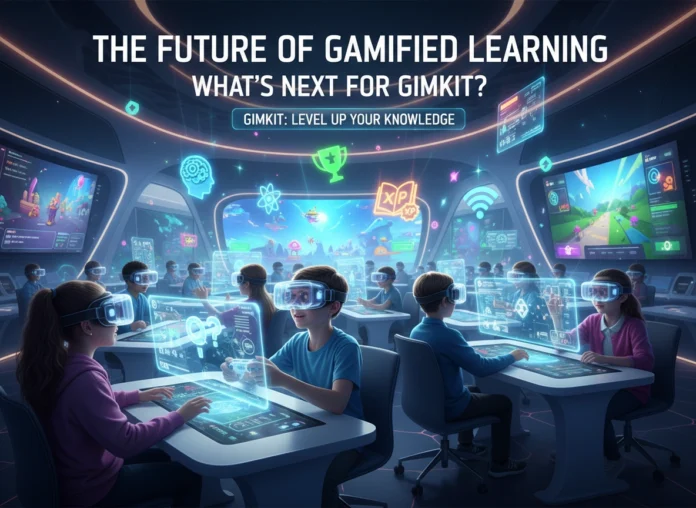


The traditional classroom is rapidly disappearing. Rows of desks facing a chalkboard are being replaced by dynamic, interactive environments where students don’t just consume information—they play with it. At the heart of this shift lies gamified learning, a strategy that borrows elements from video games to make education addictive in the best possible way.
While platforms like Kahoot! and Quizizz laid the groundwork, Gimkit has emerged as a powerhouse, pushing the boundaries of what educational gaming can look like. Created by a high school student who was bored with existing review games, Gimkit introduced an economy-based system that revolutionized student engagement.
This article explores the trajectory of gamified learning, examines how Gimkit has transformed modern classrooms, and offers bold predictions for the future of this innovative platform.
The Evolution of Gamified Learning
To understand where we are going, we must look at where we started. Gamification in education isn’t new. Teachers have used gold stars and leaderboard charts for decades. However, digital integration has supercharged these concepts.
From Points to Immersion
Early educational software focused heavily on the “chocolate-covered broccoli” approach. Developers took boring drills and slapped a thin layer of game mechanics on top. You answered math problems to move a car forward. It was functional, but it wasn’t fun.
Today, the landscape is different. Modern gamification focuses on intrinsic motivation. Students aren’t just earning points; they are building strategies, managing resources, and collaborating with peers. The game mechanics are deeply scrutinized to ensure they support the learning objectives rather than distracting from them.
The Shift to Active Participation
Passive learning is losing its grip on education. Studies consistently show that active recall and immediate feedback—two pillars of gamified learning—significantly improve retention rates. Platforms like Gimkit force students to make decisions constantly. They aren’t just recalling a fact; they are deciding whether to invest their in-game currency in a power-up or save it for a multiplier. This adds a layer of critical thinking that simple quiz games often lack.
How Gimkit Transformed Classroom Engagement
Gimkit didn’t just join the market; it disrupted it. By introducing game modes that feel like actual video games (such as “Trust No One,” inspired by Among Us), it bridged the gap between home entertainment and schoolwork.
The Economy of Learning
The core innovation of Gimkit is its in-game economy. Students earn virtual money for correct answers. They can then spend this money on upgrades to earn money faster.
This mechanic introduces strategic depth. A student who answers 10 questions slowly but invests wisely might beat a student who answers 20 questions quickly but ignores the shop. This levels the playing field, allowing different types of learners to succeed. It teaches resource management alongside the core subject matter, providing a dual-layered learning experience.
Reducing Anxiety through Repetition
Traditional testing induces anxiety. Gamified platforms reduce this stress by normalizing failure. In a Gimkit session, a wrong answer isn’t a permanent mark on a record; it’s a minor setback that can be overcome with a few correct answers.
The platform encourages repetition without monotony. Because the goal is to earn money or survive a game mode, students willingly answer the same questions multiple times. This repetition is crucial for moving information from short-term to long-term memory.
Community and Customization
Gimkit empowers students to create their own “Kits” (quiz sets). This turns learners into teachers. When students have to formulate questions and answers for their peers, they engage with the material at a much deeper level. The “Ink” tool further allows for creative expression, letting students draw and share their work within the game context.
Predicting the Future: What’s Next for Gimkit?
The educational technology sector is moving fast. Artificial Intelligence (AI), Virtual Reality (VR), and personalized learning algorithms are reshaping the landscape. Here is where Gimkit and the broader world of gamified learning are likely headed.
1. Deep AI Integration
AI is the next frontier. Currently, teachers spend hours creating question sets. In the near future, we can expect Gimkit to integrate generative AI that builds entire game sets from a simple prompt or a uploaded PDF of a textbook chapter.
Beyond content creation, AI could serve as a dynamic difficulty adjuster. The game could analyze a student’s performance in real-time. If a student struggles with a specific concept, the AI could subtly introduce more practice questions on that topic or offer hints, ensuring the challenge level remains optimal—neither too boring nor too frustrating.
2. Expanded “Game Modes” as Micro-Learning Worlds
Gimkit’s “2D” modes, where students move avatars around a map, hint at a future of mini-metaverses. We will likely see these worlds expand into persistent learning environments.
Imagine a semester-long game where a student’s avatar retains progress across different subjects. Success in history class might unlock a specific item or area that helps them in a collaborative science project. This persistence would build long-term engagement, turning the entire school year into a cohesive narrative journey.
3. The Rise of Hybrid Reality
While fully immersive VR might be too expensive for every classroom, Augmented Reality (AR) is accessible via standard tablets and smartphones. Future versions of Gimkit could allow students to scan their physical classroom environment to find clues or answer questions.
For example, a biology class could use Gimkit to “capture” virtual specimens hiding around the room, answering questions to catalog them. This blends physical movement with digital learning, catering to kinesthetic learners who struggle to sit still.
4. Advanced Analytics for Educators
Data is powerful, but only if it’s readable. Future updates will likely provide teachers with even more granular insights. instead of just seeing who won, teachers might see data on how students won.
Did a student rely on guessing? Did they hesitate consistently on a specific type of question? Predictive analytics could alert teachers to students who are at risk of falling behind weeks before a major exam, allowing for timely intervention.
5. Cross-Platform Interoperability
Siloed ecosystems are frustrating for educators. The future of EdTech lies in integration. We may see Gimkit partnering with major Learning Management Systems (LMS) like Canvas or Google Classroom more deeply.
Imagine grades syncing automatically, or Gimkit assignments being triggered by completion of a video lesson in another app. Seamless interoperability will reduce administrative friction, letting teachers focus on teaching rather than tech support.
Challenges on the Horizon
Despite the optimism, the future of gamified learning faces hurdles.
- The Novelty Effect: Gamification works well when it’s fresh. If every lesson is a game, students may become desensitized. Developers must constantly innovate to keep the experience engaging without it becoming exhausting.
- Equity and Access: High-tech solutions require reliable internet and hardware. The “digital divide” remains a significant barrier. Future developments must prioritize accessibility, ensuring that gamified learning works on older devices and slower connections.
- Balancing Fun and Rigor: There is always a risk that the “game” overshadows the “learning.” Developers must ensure that game mechanics do not allow students to bypass the educational content through loopholes or purely strategic gameplay that ignores the subject matter.
Conclusion
The future of gamified learning is not just about better graphics or faster apps; it is about creating deeper, more meaningful connections between students and the material they need to master.
Gimkit has proven that school doesn’t have to be boring to be effective. By leveraging the psychology of gaming—risk, reward, and immediate feedback—it has transformed review sessions into high-energy events.
As we look forward, the convergence of AI, persistent game worlds, and advanced analytics promises to make platforms like Gimkit even more integral to the educational ecosystem. For educators, the message is clear: the game is just beginning.
Next Steps for Educators
- Experiment with New Modes: Don’t stick to the standard quiz. Try Gimkit’s creative modes like “Draw That” or “Fishtopia” to engage different student strengths.
- Student-Led Content: Assign students to create their own Gimkit sets as a review project.
- Stay Updated: Follow the Gimkit blog and social channels to catch new features and AI integrations as soon as they launch.
Please click here for more info.