

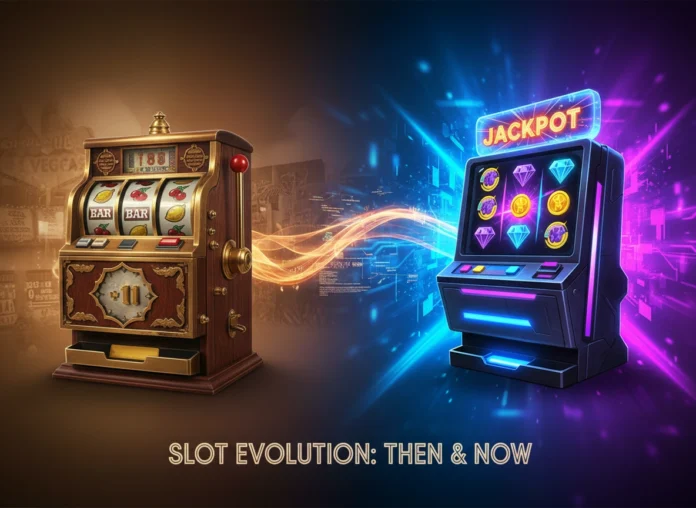


Walk into any casino floor from Las Vegas to Macau, and you are greeted by a symphony of sounds. Bells chime, digital coins clatter, and bright lights flash in rhythmic patterns. But the modern slot machine—a sophisticated computer housed in a flashy cabinet—bears little resemblance to its mechanical ancestor. What started as a simple novelty in a San Francisco mechanic’s shop has evolved into a multi-billion dollar global industry that anchors both land-based and online gaming economies.
This article traces the fascinating journey of the slot machine. We will explore its humble mechanical origins, the mid-century electromechanical revolution, and the sweeping digital transformation that brought the casino experience into our pockets.
The Birth of the One-Armed Bandit
The story begins in the late 19th century. While poker machines based on card hands existed earlier, the true ancestor of the modern slot is widely credited to Charles Fey. In 1895, Fey, a mechanic in San Francisco, simplified the gaming concept to create the Liberty Bell.
Simplicity was Key
Previous gambling machines required an attendant to make payouts because the possible winning combinations based on poker hands were too vast to automate. Fey’s innovation was reduction. He reduced the machine to three spinning reels and just five symbols: horseshoes, diamonds, spades, hearts, and the Liberty Bell.
By limiting the variables, Fey could devise an automatic payout mechanism. Three Liberty Bells in a row awarded the top prize: fifty cents (about $18 today). The machine was a massive success. Its lever on the side gave birth to the nickname “one-armed bandit,” a term that stuck even as the technology evolved.
The Era of Fruit Machines
As slot machines gained popularity, they also attracted regulatory scrutiny. By the early 1900s, anti-gambling laws threatened the industry. Manufacturers like Herbert Mills (who created the Operator Bell) found a clever workaround. Instead of cash, machines dispensed gum or candy.
This necessity birthed the iconic fruit symbols we still see today. The cherries, melons, and lemons corresponded to the flavor of gum a player would win. The “BAR” symbol, now a staple of slot design, was originally the logo of the Bell-Fruit Gum Company. Even after cash payouts returned, the fruit symbols remained, cementing their place in pop culture.
The Electromechanical Revolution
For decades, slot machines remained purely mechanical. You pulled a lever, springs tensioned, and gears spun. But the post-World War II era brought a hunger for technological advancement. In 1963, Bally Manufacturing introduced the Money Honey, a machine that changed the industry forever.
Why Money Honey Mattered
The Money Honey was the first fully electromechanical slot machine. While it still featured the traditional lever, the reels were operated electrically. This seemingly small shift allowed for new gameplay features:
- Multi-coin bets: Players could wager more than one coin per spin.
- Bottomless hoppers: The machine could hold larger amounts of coins and payout up to 500 coins automatically without an attendant.
- Lights and Sound: Electricity allowed for flashing lights and more complex sound effects, increasing the sensory appeal of the game.
This innovation shifted the economics of casinos. Before Money Honey, table games ruled the floor. After its introduction, slots began their steady march toward dominance, eventually occupying over 70% of the average casino’s floor space.
The Digital Shift: The Video Slot Era
In 1976, the next great leap occurred. Fortune Coin Co., based in Las Vegas, developed the first video slot machine. The physical reels were gone, replaced by a 19-inch Sony Trinitron color receiver.
Skepticism and Acceptance
Players were initially suspicious. Without physical reels spinning, how could they trust the result? It felt less tangible, less fair. It took approval from the Nevada State Gaming Commission and rigorous testing to convince players that the digital outcome was just as random as the mechanical one.
Video slots opened the door to features that were physically impossible with mechanical reels. Developers could now offer:
- Bonus rounds: Second-screen games that offered different mechanics.
- More paylines: Instead of a single line across the middle, wins could zigzag, go diagonal, or form shapes.
- The RNG: This era solidified the use of the Random Number Generator (RNG), a microchip that generates thousands of number sequences per second, determining the outcome the moment the player hits “spin.”
The Internet Age and Online Slots
The 1990s brought the internet, and the gambling industry was quick to adapt. In 1994, Microgaming developed the first online casino software. This marked the beginning of the most significant expansion in the history of slots.
Accessibility and Variety
The transition to online platforms removed the physical constraints of a casino. A digital lobby could host thousands of games, not just what fit on the floor. This led to an explosion in creativity. Themes expanded beyond fruit and bells to include ancient civilizations, space exploration, and licensed properties from movies and TV shows.
The Rise of Mobile Gaming
The launch of the smartphone in the late 2000s catalyzed the next phase. Developers optimized games for touchscreens, allowing players to spin the reels while commuting or waiting in line. The convenience factor was undeniable. Mobile gaming now accounts for a significant majority of online slot revenue.
Mechanics of Modern Digital Slots
The transformation from mechanical gears to software code has fundamentally changed how the games work. Understanding these mechanics provides insight into their enduring popularity.
Return to Player (RTP) and Volatility
Digital slots operate on precise mathematical models.
- RTP: This percentage indicates how much money wagered is paid back to players over time. While a mechanical machine might have had a fixed, difficult-to-change RTP, digital slots can be adjusted by developers (within regulatory limits) to balance profitability with player satisfaction. Online slots generally offer higher RTPs (95-98%) compared to land-based machines (85-90%) due to lower overhead costs.
- Volatility: This measures risk. High volatility slots pay out less frequently but offer massive jackpots. Low volatility slots offer frequent, smaller wins to keep players engaged. Digital platforms allow players to choose games that match their specific risk tolerance.
Gamification Elements
Modern slots borrow heavily from video gaming culture. They are no longer just about matching symbols. They include:
- Level-up systems: Players unlock new content the longer they play.
- Narrative arcs: Some slots tell a story that progresses as you win.
- Skill-based bonus rounds: While the main game remains luck-based, some jurisdictions now allow bonus rounds where hand-eye coordination or strategy can influence the payout.
Cultural Impact and Responsible Gaming
The ubiquity of digital slots has woven them into the fabric of entertainment culture, but it has also raised serious questions about responsible gaming.
The Psychology of the “Near Miss”
Digital slots are expertly designed to trigger dopamine responses. The “near miss”—where two jackpot symbols line up, and the third falls just short—is a powerful psychological hook. In the mechanical era, a near miss was a physical accident. In digital slots, near misses are often programmed intentionally to keep engagement high without awarding a payout.
Regulatory Response
As slots moved online, regulation had to cross borders. Licensing bodies like the UK Gambling Commission and the Malta Gaming Authority enforce strict standards on fairness and player protection. Features like “reality checks” (reminding players how long they’ve been playing) and mandatory deposit limits are direct responses to the efficiency of digital slot design.
The Future: VR, AR, and Blockchain
What lies ahead for the humble slot machine? The industry is currently experimenting with several frontier technologies.
Virtual Reality (VR) and Augmented Reality (AR)
VR slots aim to bring the immersion of a land-based casino into the home. Players can put on a headset and walk through a virtual casino floor, interacting with machines and other players in 3D space. While still a niche, this technology offers a social component that standard online slots lack.
Blockchain and Provably Fair Gaming
Cryptocurrency casinos are introducing “provably fair” algorithms. These allow players to verify the randomness of every spin using blockchain technology. This transparency addresses the age-old skepticism that dates back to the first video slots in the 1970s.
Skill-Based Hybrid Games
To attract younger demographics who grew up on Xbox and PlayStation, developers are creating hybrid games. These might look like a first-person shooter or a puzzle game, where your skill determines your success, but the rewards are monetary. This represents a full circle moment: moving away from pure chance back to a degree of player agency.
Conclusion
From Charles Fey’s Liberty Bell to the immersive VR experiences of today, the slot machine has proven to be remarkably resilient. It has survived bans, adapted to new technologies, and shifted forms from iron to code.
The core appeal remains unchanged: the thrill of the unknown and the possibility of a life-changing win from a small wager. As technology continues to accelerate, the “one-armed bandit” will undoubtedly find new ways to reinvent itself, ensuring that the reels keep spinning well into the future.
Next Steps:
If you are interested in the mechanics behind these games, consider researching the mathematics of RNG (Random Number Generators). For those interested in the industry side, look into the current legislative changes regarding online gaming in your specific region.
Please click here for more info.